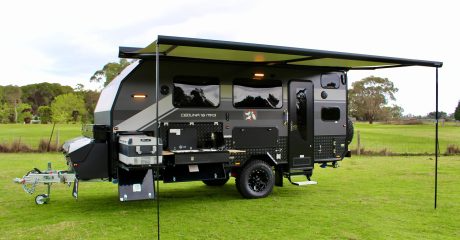
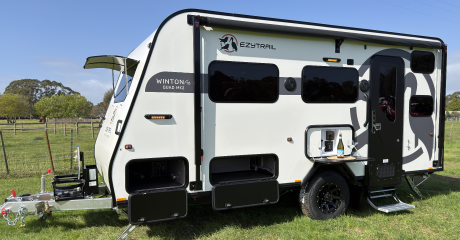
Designed for duo travellers (Or solo adventurers), the Airlie 11 HR Twin is the perfect compact off-road caravan for those seeking comfort and versatility.
The Airlie 18R is built for those who crave adventure without compromise, featuring an innovative rear-door design that enhances flow, space, and accessibility.
The Airlie 20R is a feature-packed off-road caravan, designed for luxury on the go. Inside, enjoy a modern kitchen, an abundance of storage, and a built-in washing machine for added convenience.
The Airlie 23 is designed for families who crave adventure without sacrificing luxury. Featuring four spacious bunks, a plush island bed, and endless storage.
The Parkes 14R Twin MK4 proves you don’t need extra length to travel without limits. Built for duo-travellers who want genuine off-road capability paired with modern comfort, this hybrid is engineered to go further with confidence.
The Parkes 15FRS Club redefines what compact touring can feel like. With both a fridge and microwave, it delivers practical convenience without compromising space.
Built for travellers who demand more, this van pairs massive 1190W solar capacity with a huge 12kWh lithium bank and full smart-system integration throughout.
The Parkes 16R Quad MK4 delivers serious off-road capability with the flexibility modern families need. Up front, a king bed easily folds away to create additional seating, while two bunks ensure everyone has their own space to recharge. An internal ensuite brings everyday convenience on the road, and the electric pop-top roof makes setup effortless — just press a button and relax.
Designed for couples who want serious off-road capability without the setup hassle, the Parkes 16R Twin MK4 makes adventure feel effortless. The permanent king bed means no unpacking — simply press a button, raise the electric roof and relax.
Finished with extensive external storage and a rear utility box, the Parkes 16R 3 Bunk is designed for families who want space, strength and freedom wherever the road leads.
The Ceduna 13R Twin MK4 is built for duo-travellers who want to go further without towing bigger. This agile hybrid blends genuine off-road capability with modern, homely comfort — proving compact doesn’t mean compromise. Powered by a 24V Victron system, you’ll have smart, reliable energy wherever adventure calls.
The Ceduna 15FRS Club MK4 is designed for travellers who want room to breathe without sacrificing capability. The rear club lounge creates a genuine living zone — more space to relax, dine and stretch out in comfort.
Built for adventurous families, the Ceduna 16R 3 Bunk MK4 combines serious off-road capability with the power, storage and comfort needed to make more of every journey.
The Ceduna 17F Twin MK4 is designed for travellers who want space, style and serious cooking capability on the road. Its open floor plan creates a light, spacious feel, centred around a true monster kitchen made for extended touring. Outside, the innovative parallel slide-out kitchen and external pantry offer added protection from the elements while expanding your prep space.
The Ceduna 17F Quad MK4 is designed to give families the space they need without compromising capability. A generous open-plan layout creates an airy, expansive feel, anchored by a true monster kitchen built for extended touring and serious meal prep. Outdoors, the parallel slide-out kitchen and external pantry enhance functionality while offering greater protection from the elements.
The VZ4800 HR Twin blends refined comfort with rugged off-road performance, delivering a touring experience that feels effortless from setup to sundown.
Ezytrail’s Winton 10 just levelled up. The all-new MK2 brings your favourite compact caravan to the next stage of comfort, convenience, and cutting-edge tech.
The Winton 13 MK2 is Ezytrail’s latest evolution in compact caravanning — a smart, spacious, and fully loaded 13ft van built for couples who want big features without the bulk.
from $59,990$54,990+ Dealer Delivery & On Road Costs.
or $192 a week
The Winton 16F Twin combines modern comfort and smart technology in a streamlined 16ft layout, featuring a queen island bed, self-contained ensuite, café lounge with sofa bed and spacious kitchen.
The right caravan solar battery capacity depends on how you travel, how long you plan to stay off-grid, and which appliances you want to use. This guide explains solar generation, daily loads, and battery storage, with an Ezytrail model example.
Guides
Imagine pulling up at a quiet campsite, well beyond the nearest powered site. You’ve got a fridge full of food, lights for the evening, and a few devices to charge. Everything seems perfect until you start wondering whether your batteries will last through the night. That’s when choosing the right caravan solar battery capacity matters.
No single number suits every traveller. Your ideal setup depends on where you travel, how long you stay off-grid, and what you want to power while you are there. Too little power may leave you checking your battery levels constantly, while a suitable setup gives you more freedom to enjoy your trip.
How Much Solar Power Does a Caravan Need?
Caravan usage
Indicative solar capacity
Basic weekend trips with minimal appliances
200–400W
Regular touring with a fridge, lights, and charging
400–600W
Extended off-grid trips with higher electricity use
600–1000W+
High-power setups with air conditioning and other appliances
1000W+ with substantial battery storage
These figures are starting points, not fixed requirements. Actual performance depends on sunlight, weather, panel positioning, and electricity consumption. A well-matched caravan solar system should generate enough electricity during the day to support your appliances and help recharge the battery for overnight use.
Air conditioning can draw significant power: 1000W of panels alone does not guarantee continuous operation. Have a qualified caravan electrical specialist size the panels, battery, inverter, and charging equipment for your expected loads.
Understanding Your Caravan’s Daily Power Needs
Before choosing solar panels or batteries, start by looking at how much electricity you use each day. Every appliance draws a different amount of power. A fridge running throughout the day will use more energy than a few LED lights switched on at night.
Appliance wattage × hours used = daily watt-hours (Wh)
Appliance
Estimated daily consumption
Caravan fridge
600Wh
LED lighting
80Wh
Phone and device charging
100Wh
Water pump
60Wh
Television
120Wh
Total
960Wh
These are illustrative figures. Actual consumption varies by appliance model and usage.
Simple Daily-Load Calculator
Write down each appliance’s wattage and estimated hours of use. Multiply the two figures, then add all the daily watt-hours. For example, 40W × 2 hours = 80Wh. Divide your total Wh by 1000 to convert it into kWh; 960Wh = 0.96kWh per day. Allow extra capacity for system losses, poor weather, and changing habits.
How Much Caravan Solar Battery Capacity Is Enough?
Solar panels generate electricity when sunlight is available, while batteries store energy for evenings, cloudy conditions, and periods without solar generation. For a 12.8V nominal lithium battery caravan system, the approximate nominal storage capacity is:
100Ah: 1.28kWh
200Ah: 2.56kWh
300Ah: 3.84kWh
400Ah: 5.12kWh
These calculations assume a 12.8V nominal battery voltage. Usable energy will be lower after accounting for battery operating limits and conversion losses. That is why choosing the right caravan solar battery capacity means considering both daily electricity use and how long you want your batteries to last.
As a rough illustration, a 960Wh daily load for two days is 1.92kWh before losses or reserve. A 200Ah, 12.8V battery stores 2.56kWh nominally, but actual suitability depends on usable depth of discharge, inverter losses and recharging opportunities.
Why Consider a Lithium Battery for Your Caravan?
Battery capacity alone is not enough. Your inverter, solar charge controller and charging equipment must also suit the appliances you intend to operate. A lithium battery caravan setup can be useful for travellers planning extended stays away from powered sites.
Compared with traditional lead-acid batteries, suitable lithium batteries generally offer:
More usable energy for a given rated capacity.
Lower weight for comparable storage.
Faster charging when supported by the charging system.
Longer cycle life under suitable operating conditions.
However, lithium batteries require compatible chargers, battery management systems, and appropriate installation.
For a real-world comparison, review the Ceduna 16R Quad MK4 specifications. The product page describes a 24V lithium power system, approximately 12kWh battery storage, and roof solar. This is a higher-capacity example, not a standard requirement for every caravan or a promise of unlimited air-conditioning runtime. Confirm the current fitted configuration with Ezytrail before purchasing.
Specifications, standard inclusions and options can change by model, production date and configuration. Always check the current product page and confirm details with Ezytrail.
How Many Amp-Hours Do I Need for Off-Grid Caravan Power?
Start with your daily watt-hours, multiply by the number of days you want without reliable charging, then account for usable battery capacity and system losses. At 12.8V, 960Wh is about 75Ah of nominal battery energy for one day (960 ÷ 12.8). This is not a complete battery-sizing recommendation: allow for reserve, charging conditions, and the battery’s permitted discharge range.
Choose a Caravan That Suits Your Travel Plans
The right caravan solar battery capacity ultimately depends on how you want to travel. Someone moving regularly between powered sites will have different requirements from a family planning longer stays in remote locations. Rather than choosing based on solar wattage or battery size alone, look at the complete power system and how it fits your travel plans.
Choosing the right caravan starts with understanding your vehicle’s towing capability. This guide explains how to match your car with a suitable caravan by looking at towing capacity, caravan weights, and key specifications. Learn what factors to consider before purchasing and find an Ezytrail caravan that suits your vehicle and touring plans.
Understanding caravan weights is essential when choosing a caravan that matches your towing setup. This guide explains common terms including ATM, tare weight, GTM, ball weight, GVM and GCM, helping buyers understand caravan specifications and making informed decisions when comparing Ezytrail caravan models.
Discover the various caravan finance options available before you decide to buy a caravan in Australia. Learn how to work out what you can comfortably afford.
Get in touch to book a viewing at your nearest Ezytrail showroom. One of our friendly team members will reach out to you directly to organise the best time for you to stop by!
 Touring Range


 Touring Range