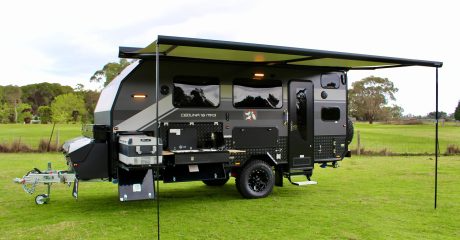
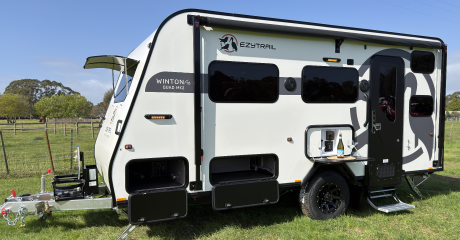
Designed for duo travellers (Or solo adventurers), the Airlie 11 HR Twin is the perfect compact off-road caravan for those seeking comfort and versatility.
The Airlie 18R is built for those who crave adventure without compromise, featuring an innovative rear-door design that enhances flow, space, and accessibility.
The Airlie 20R is a feature-packed off-road caravan, designed for luxury on the go. Inside, enjoy a modern kitchen, an abundance of storage, and a built-in washing machine for added convenience.
The Airlie 23 is designed for families who crave adventure without sacrificing luxury. Featuring four spacious bunks, a plush island bed, and endless storage.
The Parkes 14R Twin MK4 proves you don’t need extra length to travel without limits. Built for duo-travellers who want genuine off-road capability paired with modern comfort, this hybrid is engineered to go further with confidence.
The Parkes 15FRS Club redefines what compact touring can feel like. With both a fridge and microwave, it delivers practical convenience without compromising space.
Built for travellers who demand more, this van pairs massive 1190W solar capacity with a huge 12kWh lithium bank and full smart-system integration throughout.
The Parkes 16R Quad MK4 delivers serious off-road capability with the flexibility modern families need. Up front, a king bed easily folds away to create additional seating, while two bunks ensure everyone has their own space to recharge. An internal ensuite brings everyday convenience on the road, and the electric pop-top roof makes setup effortless — just press a button and relax.
Designed for couples who want serious off-road capability without the setup hassle, the Parkes 16R Twin MK4 makes adventure feel effortless. The permanent king bed means no unpacking — simply press a button, raise the electric roof and relax.
Finished with extensive external storage and a rear utility box, the Parkes 16R 3 Bunk is designed for families who want space, strength and freedom wherever the road leads.
The Ceduna 13R Twin MK4 is built for duo-travellers who want to go further without towing bigger. This agile hybrid blends genuine off-road capability with modern, homely comfort — proving compact doesn’t mean compromise. Powered by a 24V Victron system, you’ll have smart, reliable energy wherever adventure calls.
The Ceduna 15FRS Club MK4 is designed for travellers who want room to breathe without sacrificing capability. The rear club lounge creates a genuine living zone — more space to relax, dine and stretch out in comfort.
Built for adventurous families, the Ceduna 16R 3 Bunk MK4 combines serious off-road capability with the power, storage and comfort needed to make more of every journey.
The Ceduna 17F Twin MK4 is designed for travellers who want space, style and serious cooking capability on the road. Its open floor plan creates a light, spacious feel, centred around a true monster kitchen made for extended touring. Outside, the innovative parallel slide-out kitchen and external pantry offer added protection from the elements while expanding your prep space.
The Ceduna 17F Quad MK4 is designed to give families the space they need without compromising capability. A generous open-plan layout creates an airy, expansive feel, anchored by a true monster kitchen built for extended touring and serious meal prep. Outdoors, the parallel slide-out kitchen and external pantry enhance functionality while offering greater protection from the elements.
The VZ4800 HR Twin blends refined comfort with rugged off-road performance, delivering a touring experience that feels effortless from setup to sundown.
Ezytrail’s Winton 10 just levelled up. The all-new MK2 brings your favourite compact caravan to the next stage of comfort, convenience, and cutting-edge tech.
The Winton 13 MK2 is Ezytrail’s latest evolution in compact caravanning — a smart, spacious, and fully loaded 13ft van built for couples who want big features without the bulk.
from $59,990$54,990+ Dealer Delivery & On Road Costs.
or $192 a week
The Winton 16F Twin combines modern comfort and smart technology in a streamlined 16ft layout, featuring a queen island bed, self-contained ensuite, café lounge with sofa bed and spacious kitchen.
What Caravan Can My Car Tow? An Australian Matching Guide
Choosing the right caravan starts with understanding your vehicle’s towing capability. This guide explains how to match your car with a suitable caravan by looking at towing capacity, caravan weights, and key specifications. Learn what factors to consider before purchasing and find an Ezytrail caravan that suits your vehicle and touring plans.
Ezy TipsGuides
Choosing the right caravan is not only about finding a layout, features or design that suits your travelling style. One of the most important questions every caravan buyer should ask is: what caravan can my car tow?
Understanding your vehicle’s towing limits helps you choose a caravan that matches your setup and ensures you are making an informed decision before hitting the road. Whether you are planning weekend adventures, long-distance touring or off-road exploration, matching your vehicle with the right caravan is an essential part of the buying process.
At Ezytrail, we understand that every traveller has different needs. From compact touring setups to larger off-road caravans, choosing a caravan that aligns with your vehicle specifications, travel plans and towing requirements is key to enjoying your journey.
Understanding Caravan Towing Capacity in Australia
When researching for caravan towing capacity in Australia, it is important to understand that every vehicle has specific limits set by the manufacturer. The practical limit is the lowest applicable vehicle, caravan, or component limit, rather than only the advertised towing rating.
Your vehicle’s towing capacity can depend on several factors, including:
Vehicle make and model
Engine and drivetrain specifications
Braked and unbraked towing ratings
Towbar rating
Payload capacity, including the effect of actual towball mass
Number of passengers and additional equipment
A vehicle may have a high towing capacity on paper. But the actual towing ability can change depending on how the vehicle and caravan are loaded. Passengers, fuel, accessories, cargo and towball mass all consume vehicle payload.
How Do I Know What Caravan My Car Can Tow?
The answer to what caravan can my car tow depends on comparing all relevant vehicle, caravan and component limits with the actual travel-ready weights.
Before choosing a caravan, check the braked and unbraked towing ratings, GVM, GCM, front and rear axle limits, payload, towbar and hitch ratings, tyre ratings, and these important caravan measurements:
ATM (Aggregate Trailer Mass)
ATM refers to the maximum weight of the caravan when it is fully loaded and disconnected from the towing vehicle. This includes the caravan itself, water, gas, luggage, and accessories.
Tare Weight
Tare weight is the caravan’s mass in the manufacturer’s specified tare condition. Confirm which items are included under the national light-trailer standard, water and waste tanks are not treated as full when tare is established.
Payload Capacity
Payload refers to how much additional weight can be added to the caravan, including camping equipment, food, clothing, and travel accessories. As a planning check, it is generally ATM minus tare, subject to the manufacturer’s stated inclusions.
Towball Mass
Towball mass is the actual downward load placed on the vehicle by the caravan. It changes with tank levels, cargo and load position, and must remain within the vehicle’s payload, rear-axle, towbar, hitch and coupling limits.
Understanding these measurements makes it easier to compare your vehicle with different caravan models.
Using a Caravan Towing Capacity Calculator
A towing capacity calculator can be a useful planning aid when researching caravan options. These tools help caravan buyers understand whether their vehicle may be suitable for different caravan weights. However, calculations must be checked against the vehicle manufacturer’s specifications, caravan ratings, component limits, and actual loaded weights. Factors such as passengers, fuel, accessories, water tanks and additional equipment can all affect your final towing setup. Weigh the complete travel-ready combination at a certified public weighbridge before travel and after major loading changes.
Worked Matching Example
For example, a vehicle with a 2,500 kg braked towing rating may still be unsuitable for a 2,400 kg loaded caravan. If people, fuel and accessories leave only 400 kg of vehicle payload and the caravan applies 240 kg of actual towball mass, the vehicle may exceed GVM or its rear-axle limit even though the caravan is below the advertised towing rating. Check every limit and verify the loaded combination by weighing.
How Towing Rules Differ Across Australia
National construction requirements are broadly aligned: brakes are generally required above 750 kg GTM, and trailers above 2,000 kg GTM require brakes on all wheels and an automatic breakaway system. Road rules, licensing, registration, and inspection requirements can differ. The following points were checked against current government guidance; always recheck before travel.
Jurisdiction
Important local difference
Official source
NSW
P1 car license holders may tow only a small trailer up to 250 kg unloaded. A 100 km/h maximum applies when the combination exceeds 4.5 t GCM, or the tow vehicle exceeds 4.5 t GVM.
Learner and P1 drivers generally cannot tow except in limited circumstances. Caravans must be registered and roadworthy, and nothing may be towed behind a caravan.
The driver is responsible for manufacturers and loaded-mass limits. A current safety certificate is required for specified light-trailer registration or transfer transactions.
A 100 km/h maximum applies while towing. Drivers must generally remain at least 60 m behind a heavy vehicle or another towing vehicle unless overtaking.
A pre-registration inspection is required for a trailer that has never been registered, has lapsed by three months or more, or is transferred from interstate.
Choosing the Right Ezytrail Caravan for Your Vehicle
The right caravan depends on how you travel and what your vehicle can comfortably support. A smaller caravan may suit travellers looking for easier towing and flexibility, while larger off-road caravans may require vehicles with higher towing capability.
Ezytrail offers a range of caravans designed for different travel styles, including options for touring, family adventures and off-road exploration.
Explore the full Ezytrail range of caravans to compare different layouts, features, and specifications. When comparing models, review key details such as:
Caravan ATM and tare weight
Sleeping capacity
Off-road features
Storage requirements
Travel accessories
You can also review individual caravan specifications to better understand the weight and features of each model before making a decision.
Common Mistakes When Matching a Car and Caravan
Many first-time caravan buyers focus heavily on the caravan design without considering the complete towing setup. Some common mistakes include:
Choosing a Caravan Based Only on Size
A larger caravan may offer more space and features, but it also requires a vehicle that can handle the additional weight.
Forgetting Added Weight
Accessories, camping equipment, water tanks and personal belongings all contribute to the final towing weight.
Ignoring Towball Limits
Your vehicle’s towball capacity is just as important as its overall towing rating.
Not Planning for Future Travel
Consider how you intend to use your caravan. A setup suitable for short trips may not be the best option for longer touring or off-road adventures.
Find the Ezytrail Caravan That Matches Your Vehicle
Understanding your vehicle’s capabilities is the first step towards choosing a caravan that suits your lifestyle. By reviewing your caravan tow capacity, checking specifications and considering your travel requirements, you can make a more confident caravan purchase.
At Ezytrail, our team can help you explore caravan options that may align with your vehicle and adventure plans. Final compliance must be confirmed from the vehicle and caravan documents, actual weights and, where appropriate, advice from a qualified engineer or weighbridge operator.
The right caravan solar battery capacity depends on how you travel, how long you plan to stay off-grid, and which appliances you want to use. This guide explains solar generation, daily loads, and battery storage, with an Ezytrail model example.
Understanding caravan weights is essential when choosing a caravan that matches your towing setup. This guide explains common terms including ATM, tare weight, GTM, ball weight, GVM and GCM, helping buyers understand caravan specifications and making informed decisions when comparing Ezytrail caravan models.
Having the right caravan emergency essentials helps you deal with common issues safely and get back on the road sooner. This guide covers practical caravan recovery and safety equipment, plus other items worth keeping in your caravan or tow vehicle before you set off.
Get in touch to book a viewing at your nearest Ezytrail showroom. One of our friendly team members will reach out to you directly to organise the best time for you to stop by!
 Touring Range