Designed for duo travellers (Or solo adventurers), the Airlie 11 HR Twin is the perfect compact off-road caravan for those seeking comfort and versatility.
The Airlie 18R is built for those who crave adventure without compromise, featuring an innovative rear-door design that enhances flow, space, and accessibility.
The Airlie 20R is a feature-packed off-road caravan, designed for luxury on the go. Inside, enjoy a modern kitchen, an abundance of storage, and a built-in washing machine for added convenience.
The Airlie 23 is designed for families who crave adventure without sacrificing luxury. Featuring four spacious bunks, a plush island bed, and endless storage.
The Parkes 14R Twin MK4 proves you don’t need extra length to travel without limits. Built for duo-travellers who want genuine off-road capability paired with modern comfort, this hybrid is engineered to go further with confidence.
The Parkes 15FRS Club redefines what compact touring can feel like. With both a fridge and microwave, it delivers practical convenience without compromising space.
Built for travellers who demand more, this van pairs massive 1190W solar capacity with a huge 12kWh lithium bank and full smart-system integration throughout.
The Parkes 16R Quad MK4 delivers serious off-road capability with the flexibility modern families need. Up front, a king bed easily folds away to create additional seating, while two bunks ensure everyone has their own space to recharge. An internal ensuite brings everyday convenience on the road, and the electric pop-top roof makes setup effortless — just press a button and relax.
Designed for couples who want serious off-road capability without the setup hassle, the Parkes 16R Twin MK4 makes adventure feel effortless. The permanent king bed means no unpacking — simply press a button, raise the electric roof and relax.
Finished with extensive external storage and a rear utility box, the Parkes 16R 3 Bunk is designed for families who want space, strength and freedom wherever the road leads.
The Ceduna 13R Twin MK4 is built for duo-travellers who want to go further without towing bigger. This agile hybrid blends genuine off-road capability with modern, homely comfort — proving compact doesn’t mean compromise. Powered by a 24V Victron system, you’ll have smart, reliable energy wherever adventure calls.
The Ceduna 15FRS Club MK4 is designed for travellers who want room to breathe without sacrificing capability. The rear club lounge creates a genuine living zone — more space to relax, dine and stretch out in comfort.
Built for adventurous families, the Ceduna 16R 3 Bunk MK4 combines serious off-road capability with the power, storage and comfort needed to make more of every journey.
The Ceduna 17F Twin MK4 is designed for travellers who want space, style and serious cooking capability on the road. Its open floor plan creates a light, spacious feel, centred around a true monster kitchen made for extended touring. Outside, the innovative parallel slide-out kitchen and external pantry offer added protection from the elements while expanding your prep space.
The Ceduna 17F Quad MK4 is designed to give families the space they need without compromising capability. A generous open-plan layout creates an airy, expansive feel, anchored by a true monster kitchen built for extended touring and serious meal prep. Outdoors, the parallel slide-out kitchen and external pantry enhance functionality while offering greater protection from the elements.
The VZ4800 HR Twin blends refined comfort with rugged off-road performance, delivering a touring experience that feels effortless from setup to sundown.
Ezytrail’s Winton 10 just levelled up. The all-new MK2 brings your favourite compact caravan to the next stage of comfort, convenience, and cutting-edge tech.
The Winton 13 MK2 is Ezytrail’s latest evolution in compact caravanning — a smart, spacious, and fully loaded 13ft van built for couples who want big features without the bulk.
The Winton 16F Twin combines modern comfort and smart technology in a streamlined 16ft layout, featuring a queen island bed, self-contained ensuite, café lounge with sofa bed and spacious kitchen.
What Makes a Caravan Suitable for Australian Conditions?
Australian roads and weather are unpredictable. Learn about caravan features that matter most, including off-road capability, weather resistance, power systems, storage, and size.
Caravan Essentials
Australia’s varied roads, distances, and weather place very different demands on a caravan. A trip may involve sealed highways and regional roads. Some other adventures could include gravel roads, corrugations, uneven surfaces, or remote tracks. That means choosing a caravan is about more than finding a comfortable interior or an attractive floor plan.
The right caravan should suit the type of travel you plan to undertake, your tow vehicle, and the conditions you expect to encounter. Suspension, ground clearance, tyres, construction, water and power systems, storage and towing specifications can all influence how suitable a caravan is for your travel plans.
Understanding these factors can help you make a more informed decision when comparing caravans for Australian adventures.
1. Consider the Chassis, Suspension and Overall Construction
Australian roads are unpredictable, particularly when travelling beyond sealed highways. Corrugations, gravel, uneven surfaces, and changing terrain place considerably different demands on a caravan compared with conventional road touring.
If your plans involve travelling beyond bitumen, the chassis and suspension deserve particular attention. A strong chassis provides an important foundation. At the same time, a suspension system suited to the caravan’s intended use can help it handle uneven surfaces more effectively.
When comparing an off-road model, consider features such as:
Chassis construction
Drawbar design
Suspension system
Ground clearance
Recovery points, where applicable
Tyres and wheels
Overall caravan weight
Ezytrail’s off-road range includes models designed for different types of travel. However, specifications can vary between models. So buyers should always review the specifications of their chosen caravan rather than assuming that every model has the same equipment or capability.
2. Look at Ground Clearance, Wheels and Tyres
Ground clearance can be an important consideration when travelling on uneven or unsealed roads. Rocks, ruts, and changes in terrain can increase the risk of components underneath the caravan making contact with the ground. Tyres are also worth examining closely. Consider the tyre size, load rating,
wheel specification, and tread design for the caravan you are considering.
Wheel and tyre specifications can differ between models. For example, Ezytrail’s Airlie 11 LR Twin is equipped with 15-inch off-road alloy wheels with 235/75R15 Kenda KLEVER AT2 all-terrain tyres, while larger Airlie models use 16-inch off-road wheels and tyres.
The most suitable caravan for Australian travel isn’t necessarily the one with the longest list of features. They are the caravans whose specifications align with the type of travel you actually plan to undertake.
3. Think About Weather and Seasonal Comfort
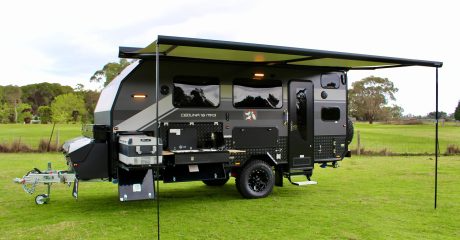
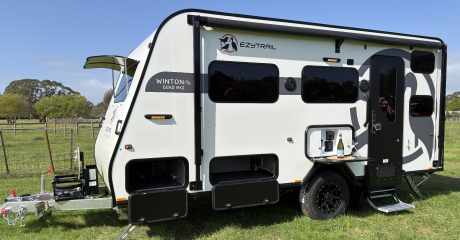
Travelling across Australia can involve significant differences in temperature and weather. Depending on your destination and the time of year, you may encounter hot conditions, cooler nights, strong winds or periods of rain. A suitable caravan should provide a comfortable living environment appropriate to the destinations and seasons you plan to experience.
Consider features such as:
Insulation
Ventilation
Windows and glazing
Heating
Air conditioning
Roof and exterior construction
Overall internal climate control
Your priorities may also change depending on where you travel. A caravan intended primarily for warm-weather coastal trips may have different requirements from one used for winter travel through colder regions. Do not assume that all caravans are equally suited to every climate. Consider the destinations you are most likely to visit and check the model specifications you are considering.
However, these descriptions should not be interpreted as a guarantee that a particular caravan will be suitable for every climate or weather event.
4. Consider Off-Grid Power Requirements
Remote travel can mean spending days away from established caravan parks and mains power. For travellers planning an extended off-grid stay, the caravan’s power system is an important consideration.
Depending on the model, systems may include:
Solar panels
Lithium battery storage
Battery management systems
Inverters
12-volt power systems
Energy monitoring
However, more power capacity is not automatically better for every traveller. Think about what you actually intend to run, including refrigeration, lighting, water pumps, heating, cooling, and other appliances. The important question is not simply how much power a caravan has, but whether its system matches the way you plan to travel.
Ezytrail’s hybrid and off-road ranges include models with different power-system configurations. Always check the current specifications for the specific model you are considering.
5. Check Water Capacity and Practical Storage
Remote travel in Australia can require greater self-sufficiency. Water capacity is therefore an important consideration if you intend to spend extended periods away from established facilities. Storage is equally important. Families may need considerably more storage than couples travelling light. When inspecting a caravan, look beyond the number of cupboards.
Ask yourself:
Where will outdoor equipment be stored?
Is there enough space for clothing and food?
Can heavier equipment be stored appropriately?
Is the storage accessible when you need it?
Will the available capacity still work when travelling with the whole family?
A caravan that feels spacious when empty can feel very different once you add the equipment needed for a longer trip. Consider how the storage layout works with your travel plans and whether you can access the items you need without compromising the available living space.
6. Pay Close Attention to Towing and Weight Limits
Choosing a capable caravan is only part of the equation. The caravan must also be suitable for your tow vehicle and comply with the relevant weight limits. Remember that water, batteries, gas, accessories, camping equipment, food, clothing and luggage all add weight. These items can significantly affect the caravan’s payload and the overall towing setup.
Key specifications include:
Tare mass – the caravan’s stated empty or base weight, according to the manufacturer’s
ATM (Aggregate Trailer Mass) – the maximum permitted mass of the loaded caravan when it is not coupled to the tow vehicle.
GTM (Gross Trailer Mass) – the maximum mass transmitted through the caravan’s wheels and axles.
Payload – the amount of additional weight the caravan can legally carry, based on its specified limits.
Tow-ball mass – the downward load imposed by the caravan on the tow vehicle’s tow
GCM (Gross Combination Mass) – the maximum permitted combined mass of the tow vehicle and trailer, where specified.
Tow vehicle limits – including the vehicle’s rated towing capacity, tow-ball rating, and other relevant manufacturer limits.
For example, the Ezytrail Airlie 11 LR Twin has a listed tare of 1,438kg, ATM of 2,000kg, GTM of 1,750kg and cargo capacity of 562kg according to its specifications. Weights and capacities can vary between models and configurations. That’s why prospective buyers should always check the current specifications for the exact caravan they are considering.
7. Choose the Right Size for Your Travel Style
There is no single caravan size that works for everyone. The right choice depends on how you travel, who travels with you, and where you intend to go. Couples who spend most of their time touring sealed roads may prefer a compact caravan that is easier to tow and manoeuvre. Families travelling for several weeks may need additional sleeping space, storage, and living areas.
When comparing family caravans for Australian conditions, think about:
Sleeping arrangements
Internal living space
Kitchen facilities
Bathroom requirements
Storage
Towing requirements
Power and water needs
The type of roads you expect to travel
The largest caravan is not necessarily the most suitable option. A smaller model may be more practical for some travellers.
8. Match the Caravan to the Terrain You Actually Travel
Your intended destinations should influence your caravan choice. If your trips mainly involve highways, sealed regional roads, and established caravan parks, an on-road caravan may meet your requirements. However, if your travels involve more challenging tracks and remote destinations, an off-road caravan may be more appropriate.
For travellers who expect a mixture of sealed and unsealed roads, a hybrid off-road caravan may offer a useful balance between touring comfort and additional capability. However, the appropriate choice depends on the actual terrain, towing vehicle, and travel conditions involved.
The best off-road caravans for Australian terrain aren’t necessarily those with the most impressive specifications. Look for a model whose capabilities, weight, dimensions, and equipment match your intended destinations. Most importantly, review the manufacturer’s specifications rather than making assumptions based on the term “off-road” alone.
Choose a Caravan That Matches Your Adventure
When looking for caravans for Australian adventures, start with the adventure itself. Think about the roads you will travel, the weather you may encounter, how long you will stay away from established facilities, and how much equipment you need to carry. Then consider the specifications that support those requirements.
Some travellers may find that a lightweight on-road caravan suits their needs. Others may prefer a hybrid for a combination of sealed and unsealed road travel. Those planning more demanding remote journeys may require an off-road caravan with specifications suited to their intended conditions.
Ezytrail offers on-road, hybrid, and off-road caravans in a range of layouts and sizes. Explore the Ezytrailcaravan range to compare your options. Visit an Ezytrail showroom to see the caravans in person and discuss your requirements with the team.
Having the right caravan emergency essentials helps you deal with common issues safely and get back on the road sooner. This guide covers practical caravan recovery and safety equipment, plus other items worth keeping in your caravan or tow vehicle before you set off.
Online caravan sales across Australia make it easier to compare models, layouts, and prices. This guide explains what to look for when buying a caravan online in Australia and how to proceed with confidence.
Long trips demand more from a van than a weekend away ever will. Ezytrail covers the features that matter most on extended journeys, covering off-grid power, water capacity, storage and comfort, so you can stay on the road longer without any headaches.
Get in touch to book a viewing at your nearest Ezytrail showroom. One of our friendly team members will reach out to you directly to organise the best time for you to stop by!
 Touring Range






 3. Think About Weather and Seasonal Comfort
 3. Think About Weather and Seasonal Comfort


