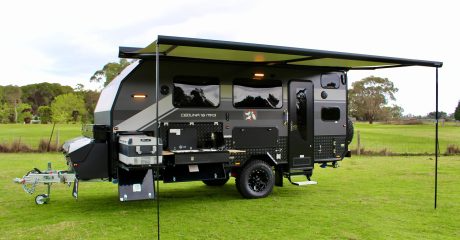
Designed for duo travellers (Or solo adventurers), the Airlie 11 HR Twin is the perfect compact off-road caravan for those seeking comfort and versatility.
The Airlie 18R is built for those who crave adventure without compromise, featuring an innovative rear-door design that enhances flow, space, and accessibility.
The Airlie 20R is a feature-packed off-road caravan, designed for luxury on the go. Inside, enjoy a modern kitchen, an abundance of storage, and a built-in washing machine for added convenience.
The Airlie 23 is designed for families who crave adventure without sacrificing luxury. Featuring four spacious bunks, a plush island bed, and endless storage.
The Parkes 14R Twin MK4 proves you don’t need extra length to travel without limits. Built for duo-travellers who want genuine off-road capability paired with modern comfort, this hybrid is engineered to go further with confidence.
The Parkes 15FRS Club redefines what compact touring can feel like. With both a fridge and microwave, it delivers practical convenience without compromising space.
Built for travellers who demand more, this van pairs massive 1190W solar capacity with a huge 12kWh lithium bank and full smart-system integration throughout.
The Parkes 16R Quad MK4 delivers serious off-road capability with the flexibility modern families need. Up front, a king bed easily folds away to create additional seating, while two bunks ensure everyone has their own space to recharge. An internal ensuite brings everyday convenience on the road, and the electric pop-top roof makes setup effortless — just press a button and relax.
Designed for couples who want serious off-road capability without the setup hassle, the Parkes 16R Twin MK4 makes adventure feel effortless. The permanent king bed means no unpacking — simply press a button, raise the electric roof and relax.
Finished with extensive external storage and a rear utility box, the Parkes 16R 3 Bunk is designed for families who want space, strength and freedom wherever the road leads.
The Ceduna 13R Twin MK4 is built for duo-travellers who want to go further without towing bigger. This agile hybrid blends genuine off-road capability with modern, homely comfort — proving compact doesn’t mean compromise. Powered by a 24V Victron system, you’ll have smart, reliable energy wherever adventure calls.
The Ceduna 15FRS Club MK4 is designed for travellers who want room to breathe without sacrificing capability. The rear club lounge creates a genuine living zone — more space to relax, dine and stretch out in comfort.
Built for adventurous families, the Ceduna 16R 3 Bunk MK4 combines serious off-road capability with the power, storage and comfort needed to make more of every journey.
The Ceduna 17F Twin MK4 is designed for travellers who want space, style and serious cooking capability on the road. Its open floor plan creates a light, spacious feel, centred around a true monster kitchen made for extended touring. Outside, the innovative parallel slide-out kitchen and external pantry offer added protection from the elements while expanding your prep space.
The Ceduna 17F Quad MK4 is designed to give families the space they need without compromising capability. A generous open-plan layout creates an airy, expansive feel, anchored by a true monster kitchen built for extended touring and serious meal prep. Outdoors, the parallel slide-out kitchen and external pantry enhance functionality while offering greater protection from the elements.
The VZ4800 HR Twin blends refined comfort with rugged off-road performance, delivering a touring experience that feels effortless from setup to sundown.
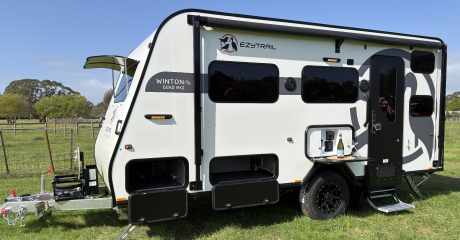
Ezytrail’s Winton 10 just levelled up. The all-new MK2 brings your favourite compact caravan to the next stage of comfort, convenience, and cutting-edge tech.
The Winton 13 MK2 is Ezytrail’s latest evolution in compact caravanning — a smart, spacious, and fully loaded 13ft van built for couples who want big features without the bulk.
The Winton 16F Twin combines modern comfort and smart technology in a streamlined 16ft layout, featuring a queen island bed, self-contained ensuite, café lounge with sofa bed and spacious kitchen.
Always make sure the tent is clean and dry when placed in the PVC cover. If the tent was wet when packed up then it must be erected as soon as possible on your return home to dry out to prevent mould stains.
Always return all zippers & mesh screens to the closed position before folding the tent.
Always have the tent fully zippered before tying down with guy ropes.
Zippers are delicate items and care must always be used when using them
To assist with fast tent set up, devise a way to keep the tent poles separate from the PVC cover
When not in use the trailer should never be left out in the open weather without a cover sheet over the PVC. The PVC cover is the one thing to keep your tent dry and problem free during times of non-use.
Although our tents/annexes are constructed to rigid specifications, they should not be left unattended for long periods of time during inclement weather. Long periods of rain may soak the ground so that pegs become loose and/or the frame uprights may sink into the ground. One or both of the above will weaken the rigidity of the overall structure since its strength depends on a taught erected condition.
Water pockets may form in the roof if the unit is not erected taught, further adding to the load on the frame supports and possibly causing a broken frame as well as roof leakage.
Ezytrail Canvas Tent Pre-Use Care Instructions
Weathering:
All products must be assembled prior to use and inspected for accuracy and parts. This also gives you an opportunity to familiarise yourself with your canvas product erection and to make sure you have all necessary components. At this time the product should be hosed with water to allow seam take up. You may find that in first wettings some leakage occurs through the seams and canvas. This is not a fault of the manufacturer, but a natural characteristic of canvas and synthetic fabrics. For this reason your canvas product must be erected and thoroughly saturated and then allowed to dry prior to its first use. This procedure (weathering) should be followed a number of times, this causes the fabric to shrink and help close up fibres and seams which may cause leakage. Do not over tension seams at this stage. Any persistent drips may need proofing with a suitable seam sealing solution.
Stitch Holes:
Every care is taken to ensure that your canvas tent is made using the finest water repellent fabric. However, canvas products are not permanent structures and in extreme conditions some water may penetrate. Seepage may occur in the seams through the needle holes created in the sewing process. This is normal and can be corrected with the application of seam sealing compound. It is suggested you purchase a wax stick or water proofing compound to keep with your camping equipment.
Storage:
Canvas products have excellent fungus resistance. As a result you can pack your canvas product wet if necessary for a short period of time. However, we recommend that the canvas product should not be left wet for more than 24 hours. Dry your canvas product thoroughly and dust off any foreign particles before storage. Fold your canvas product loosely and store in a dry place off the ground.
Cleaning:
Do not use a washing machine or any detergents as this may destroy your proofing. Remove dust, etc. with a soft brush and warm water. If it is necessary to use a mild detergent or canvas mildew remover, reproof the area with suitable waterproofing compound.
If you have packed away your canvas wet you may experience problems with mould. The best solution is to use lemon juice and water. Firstly mix 50% lemon juice with 50% water and spray it onto the affected area, scrub the canvas with a soft brush & let it dry out in the sun. Reproof the area with suitable waterproofing compound.
Wicking:
Your canvas product will not leak if you touch the canvas. However, if you rub your finger back and forth continuously on the canvas you may eventually draw water through (wicking). For this reason it is advisable not to have anything touching your canvas product. Similarly, if canvas is left to pool, water may draw through the fabric causing leakage. This is not considered to be a defect.
Zips:
All care is taken in the design to cover zips with storm flaps or position them where water will not flow. At times wind driven rain could force water under the flaps and through the zips. To minimise this, make sure all doors and windows are closed with flaps securely covering the zip wherever possible.
Ezytrail Canvas Tent Care & Use Instructions
Zipper Care:
All zippers on your canvas product will give you years of service. However, care must be taken when using your zips. Never force a zipper – reduce tension so all zippers run smoothly without straining.
Have zips closed when pegging out the tent.
Have zips open slightly (to allow air into the tent) during erection.
Before final tensioning of a tent close all zips.
Always use two hands to operate zippers.
Damaging your product from over tensioning may void your warranty.
Reducing the Risk of Jamming Fabric in the Zip:
When using the zip, hold the pull-tab between your thumb and forefinger with your thumb facing you.
As you are closing the zip, clear the way in front and under the zip slider using the back of your hand and cup the zip slider underneath with your remaining 3 fingers.
Use this action for opening or closing. Keep the fabric clear of the zip slider – zip and unzip slowly.
What to do if the Zipper Gets Caught:
Pull the fabric bit by bit out of the slider. Do not try and pull all the fabric in one go.
Do not force the slider or the fabric.
If the Slider Does Not Close the Zipper Properly:
With use the jaws of a zip slider can open slightly over time. This can be exaggerated quickly if fabric is caught into the zipper. When this occurs the slider does not compress and interlock zipper coil teeth tightly enough and the zip bursts open or does not close. To fix this, simply undo the zip and with the slider at the end of the zip lightly crimp the jaws of the zip slider together with a pair of pliers.
Crimping Instructions for a Zip Slider:
The most common reason why zips burst open is that the zip slider does not close the coil tight enough. Commonly wear and tear or fabric jamming will cause the gap marked “A” to increase, diagram below.
By gently “crimping” the slider together at points “B” and “C” with a pair of pliers, gap “A” can be adjusted most times to its correct opening, see drawing below. Crimping in other planes is worth a try if “B” and “C” fails to rectify the problem. This crimping is done when the zip slider is still attached to the zip coil and is in the fully open position.
Caring for your Galvanised Steel Poles, Pole Joiners and Zips:
Your steel poles have been hot dip galvanised to provide long life with minimum corrosion. Salt, sand, dirt and water are the enemy of any steel product and zip. Make sure the poles and zips are always clean and dry before storage. When the poles and zips have been used in damp, dusty, sandy or salty conditions they must be cleaned and coated with a thin film of oil or silicon based liquid spray before storage. Many of the frame poles are connected with pole joiners which are designed to keep your poles organised and to allow quick assembly of the pole frame. Over stretching or dropping the poles will easily damage the pole joiners and this is not covered by the warranty. Please make sure you handle the poles carefully, especially when unpacking and packing away into the carry bag.
Insurance – Your Protection against the Unexpected:
Most people have product problems from unexpected sources. Extreme weather is a good example of an unexpected problem. Make sure that you list your expensive camping products on your home and contents insurance policy. Most good insurers will cover accidental and storm damage to your Camper Trailer Tent that falls outside this warranty.
Condensation:
When warm moist air meets cooler air, condensation of water gas into water liquid occurs. The Camper Trailer Tent walls and roof form an impermeable layer between the inside and outside climatic conditions. The moisture inside the tent condenses on the canvas fabric and water droplets are formed. Sometimes these water droplets build up to appear that the fabric is leaking when in fact the cause is condensation. Condensation can be reduced if the Camper Trailer Tent is well ventilated to reduce the build- up of warm moist air on the ceiling.
Floor:
If the ground is very wet or water pools under the floor, then the downward pressure of standing or kneeling on the floor can draw water through minute wear holes in the floor fabric or where there are joins in the floor fabric. To prevent this, do not set up the camper trailer tent in hollows and make sure water drains away from the tent site.
Structural Integrity:
A well set up camper trailer tent on level ground is structurally strong and the most waterproof. During periods of prolonged rain and wind it may be necessary to tighten and adjust the frame, pegs and guy ropes as well as making sure any ground water is flowing away from the camp site. A sagging roof or awning weakens the Camper Trailer Tent structure and could allow water to pond on the roof causing leakage, structural damage and fabric tears.
Caution:
Cleaners that use bleach as an ingredient should not be used. Bleach can cause fading and lead to damage of the canvas fabric, the stitching and the waterproofing.
The pole joiners within the poles are provided for easy assembly of the frame. The pole joiners are not required for any structural reason and the poles perform perfectly well without the pole joiners. Age, over-stretching and mishandling may cause failure. Pole joiners are not covered by warranty.
Always carry a roll of heavy duty tape for simple repairs to small rips, cuts and ash burns. The tape not only blocks the hole, it will minimise any further tearing.
When removing pegs do not use the webbing attached to your Camper Trailer Tent as a handle. Either use another peg, a peg remover or the claw of a hammer hooked under the peg to remove them. A couple of taps with a hammer on the side of the peg or some twisting will often help release the peg from the ground.
If you need any further assistance the Ezytrail Team is happy to help! Give us a ring on 1300 962 267!
Having the right caravan emergency essentials helps you deal with common issues safely and get back on the road sooner. This guide covers practical caravan recovery and safety...
Discover the various caravan finance options available before you decide to buy a caravan in Australia. Learn how to work out what you can comfortably afford.
Look beyond the advertised price before buying a caravan. Learn how to compare caravan dealers, inspect different models across Sydney, ask the right questions, and find a caravan...
Get in touch to book a viewing at your nearest Ezytrail showroom. One of our friendly team members will reach out to you directly to organise the best time for you to stop by!
 Touring Range