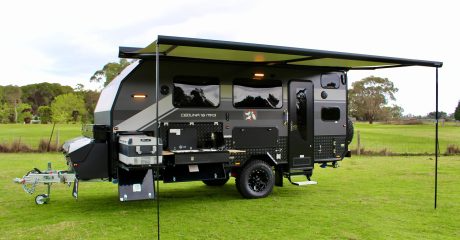
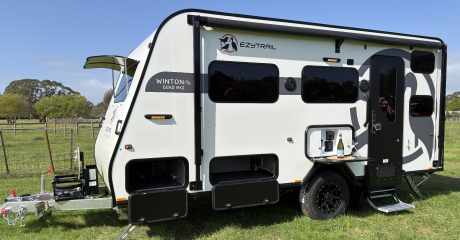
Designed for duo travellers (Or solo adventurers), the Airlie 11 HR Twin is the perfect compact off-road caravan for those seeking comfort and versatility.
The Airlie 18R is built for those who crave adventure without compromise, featuring an innovative rear-door design that enhances flow, space, and accessibility.
The Airlie 20R is a feature-packed off-road caravan, designed for luxury on the go. Inside, enjoy a modern kitchen, an abundance of storage, and a built-in washing machine for added convenience.
The Airlie 23 is designed for families who crave adventure without sacrificing luxury. Featuring four spacious bunks, a plush island bed, and endless storage.
The Parkes 14R Twin MK4 proves you don’t need extra length to travel without limits. Built for duo-travellers who want genuine off-road capability paired with modern comfort, this hybrid is engineered to go further with confidence.
The Parkes 15FRS Club redefines what compact touring can feel like. With both a fridge and microwave, it delivers practical convenience without compromising space.
Built for travellers who demand more, this van pairs massive 1190W solar capacity with a huge 12kWh lithium bank and full smart-system integration throughout.
The Parkes 16R Quad MK4 delivers serious off-road capability with the flexibility modern families need. Up front, a king bed easily folds away to create additional seating, while two bunks ensure everyone has their own space to recharge. An internal ensuite brings everyday convenience on the road, and the electric pop-top roof makes setup effortless — just press a button and relax.
Designed for couples who want serious off-road capability without the setup hassle, the Parkes 16R Twin MK4 makes adventure feel effortless. The permanent king bed means no unpacking — simply press a button, raise the electric roof and relax.
Finished with extensive external storage and a rear utility box, the Parkes 16R 3 Bunk is designed for families who want space, strength and freedom wherever the road leads.
The Ceduna 13R Twin MK4 is built for duo-travellers who want to go further without towing bigger. This agile hybrid blends genuine off-road capability with modern, homely comfort — proving compact doesn’t mean compromise. Powered by a 24V Victron system, you’ll have smart, reliable energy wherever adventure calls.
The Ceduna 15FRS Club MK4 is designed for travellers who want room to breathe without sacrificing capability. The rear club lounge creates a genuine living zone — more space to relax, dine and stretch out in comfort.
Built for adventurous families, the Ceduna 16R 3 Bunk MK4 combines serious off-road capability with the power, storage and comfort needed to make more of every journey.
The Ceduna 17F Twin MK4 is designed for travellers who want space, style and serious cooking capability on the road. Its open floor plan creates a light, spacious feel, centred around a true monster kitchen made for extended touring. Outside, the innovative parallel slide-out kitchen and external pantry offer added protection from the elements while expanding your prep space.
The Ceduna 17F Quad MK4 is designed to give families the space they need without compromising capability. A generous open-plan layout creates an airy, expansive feel, anchored by a true monster kitchen built for extended touring and serious meal prep. Outdoors, the parallel slide-out kitchen and external pantry enhance functionality while offering greater protection from the elements.
The VZ4800 HR Twin blends refined comfort with rugged off-road performance, delivering a touring experience that feels effortless from setup to sundown.
Ezytrail’s Winton 10 just levelled up. The all-new MK2 brings your favourite compact caravan to the next stage of comfort, convenience, and cutting-edge tech.
The Winton 13 MK2 is Ezytrail’s latest evolution in compact caravanning — a smart, spacious, and fully loaded 13ft van built for couples who want big features without the bulk.
The Winton 16F Twin combines modern comfort and smart technology in a streamlined 16ft layout, featuring a queen island bed, self-contained ensuite, café lounge with sofa bed and spacious kitchen.
How many times have you had someone say to you their 4WD is only getting 500km out of a tank of fuel? What does that mean to you?
Ezy Tips
How many times have you had someone say to you their 4WD is only getting 500km out of a tank of fuel? What does that mean to you? How big is the fuel tank, and how far are they running it down? What size engine, tyres, and driving habits do they have? Were they doing 90km/h on flat ground, or sitting on 110km/h up and down hills on cruise control? Fuel economy varies wildly depending on where and how you are driving. You can easily monitor your fuel economy every time you fill up; it takes a few seconds to do!
It is very useful to keep an eye on your fuel economy, as you can plan your fuel stops for future 4WD trips, ensure the vehicle is running as it should and understand how different conditions can change your fuel consumption.
Is Your Speedometer Correct?
The first thing you should really do is ensure that your speedometer is correct. If you have changed tyre sizes, there’s a good chance it won’t be! If your speedo is not correct, your trip meter won’t be either. You can do this one of two ways; drive along with a GPS at 100km on the speedometer and see what the GPS says (less accurate), or drive 100km on the vehicles trip meter, and see how many km you have done according to the GPS.
There will be a difference if you have changed tyre sizes as the bigger the tyre the less revolutions per kilometer it will do, compared to the original tyres on the vehicle. This puts your speedo out. For people that have gone from 265’s to 285’s (or 31’s to 33’s) your speedo is usually out by 5 – 10%. Fitting bigger tyres to your 4WD usually results in worse fuel economy. How much, is dependant on many factors; see the link for more information.
For our 80 series, 100km on the trip meter is actually about 105km – its out by 5% due to the larger diameter tyres.
Once you understand the difference in your speedo, you can work your fuel economy out every time you fill up. Simply remember to add 5% of your trip meter to the reading, and you can get an accurate economy figure.
Working Out Your Fuel Economy
The easiest way to work out your fuel economy is done when you fill up at a service station. Fill the tank all the way, until the nozzle clicks. Once you’ve paid, get back in your car (move out the way!) and reset the trip meter. From there, drive your vehicle around until you want to fill it up again.
When you put more fuel in, fill it up again until it clicks, and take note of the number of km you have done on your trip meter.
If you haven’t changed your tyre size, you can skip the trip meter correction step. If you have changed your tyre size, remember to factor in the extra km you have actually travelled due to the tyres.
An Example
Lets say we put 98.5L of diesel in our 80 series, and we’ve done 653.8km on the trip meter. We know the trip meter is out by 5%, so we multiply 653.8km by 1.05.
This gives us a correct reading (after factoring in the tyres) of 686.49km.
From there, simply divide the amount of fuel you’ve used (98.5L) by the number of km (686.49). The result needs to be multiplied by 100. This gives you an accurate fuel economy reading of 14.35 litres of diesel per 100km.
KM done on trip meter when filling up = 653.8
653.8 x 1.05 = 686.49km done on 98.5L of diesel.
(98.5/686.49) x 100 = 14.35 litres of diesel per 100km.
Using An App
You can use a number of different apps which work out your fuel economy and record it for you (Fuelly, Road Trip etc), but remember these won’t work out your tyre diameter changes, which makes big difference.
Don’t Rely On Your Cars Computer To Tell You
A lot of modern 4WD’s will tell you the average fuel consumption, and estimate the number of km’s you have left in the tank. This is handy, but not always very accurate. This is especially the case if you have changed your tyre sizes, as the vehicles computer works off a certain number of revolutions of the tyre per kilometer, and you’ve just changed that by fitting bigger tyres to your 4WD.
When Will I Use More Fuel In My 4WD?
4WD’s are not small, or light weight, and they do tend to use their fair bit of fuel. However, you will use a lot more fuel by doing the following
Driving In Soft Sand
Sand driving will chew the fuel
Soft sand is usually where you will go through the most fuel. This is where your vehicle is working the hardest to maintain momentum, and as a result uses more fuel. For petrol vehicles, you can use up to 50% more fuel, and diesels usually around 30% more (but this does depend on your vehicle!)
Driving At 110km/H
The difference between doing 90km/h and 100km/h is huge on your fuel economy (usually a litre or 2 per hundred km). Going from 100km/h to 110km/h is substantially more. Often this is in the realms of 1 – 2 litres per 100km too; if you have the time you can save a huge amount of money by slowing down!
Accelerating Rapidly
Your driving habits play a big role in your fuel economy too. If you are accelerating quickly, braking hard and changing throttle positions rapidly you will use more fuel!
Running Under Inflated Tyres
Under unflated tyres causes excessive fuel consumption
Your tyre pressures are critical to good fuel economy. The more you inflate them the better your economy will be. However, if you run them too hard you will have very little traction and risk having an accident. For most 4WD’s tyre pressures in between 30 and 45PSI is appropriate.
Towing A Trailer
The moment you tow something, your vehicle has to work harder. Sometimes this is made worse by wind drag, but in majority of cases its just the fact that you are dragging a weight behind your vehicle.
Roof Racks, Bigger Tyres, Different Tread Patterns And More Weight
This is going to hurt your fuel economy!
Anything that makes your vehicle work harder is going to make your fuel economy worse. by adding things to the vehicle that decrease its aerodynamics (like bar work, roof racks etc) your engine has to work harder to push the vehicle along.
If you change to a more aggressive tyre pattern, the airflow around the tyre is disrupted, and you will notice a higher consumption.
The same goes for adding more weight to your vehicle; if you put a 50kg backpack on yourself you will use a lot more energy to move around too!
Bigger tyres will make your 4WD use more fuel, as it has to work harder to turn the tyres. Even if your RPM drops at a given speed, your 4WD still has to work harder!
Sensors And Other Electrical/Mechanical Issues
For many modern vehicles, having a sensor (like the MAF) slightly dirty will send your fuel economy through the roof. These control the way the engine behaves, and if they aren’t in pristine condition you can expect poor fuel economy. The same goes for Exhaust gas recirculation systems, which tend to cake your engine up with build up. Fuel and air filters are another common cause of high fuel consumption too.
There’s a range of other things that will affect your fuel economy, but if you take the time to work it out every time you fill up, you will get an idea for yourself!
Our 80 Series 1HDT Fuel Economy
Our turbo diesel 80 series is not the most fuel efficient 4WD on the market. It’s nearly 26 years old, and has done 374,000km. We knew this when we bought it, and have been extremely happy with it.
For general driving around town and taking it easy our 80 gets around 14.5 – 15L/100km.
If we are travelling at the speed limit on longer trips with some gear in the back it seems to go up to around 16L/100km, and on our 9000km trip to the Kimberley we averaged 16.7L/100km. This included a fair bit of 4WDing, sitting at 110km/h where allowed and not really taking it too easy.
For a vehicle that weighs quite a bit, has bigger tyres, almost every accessory under the sun and is 26 years old, we are extremely happy with it.
What Fuel Economy Do You Get?
What sort of fuel economy you get in your 4WD? Let us know a bit about it, and how often you check your fuel economy!
Having the right caravan emergency essentials helps you deal with common issues safely and get back on the road sooner. This guide covers practical caravan recovery and safety...
Discover the various caravan finance options available before you decide to buy a caravan in Australia. Learn how to work out what you can comfortably afford.
Not every trip calls for a rugged off-road van. Ezytrail explains when an on-road caravan is the smarter choice, what makes these vans so well suited to sealed-road...
Get in touch to book a viewing at your nearest Ezytrail showroom. One of our friendly team members will reach out to you directly to organise the best time for you to stop by!
 Touring Range