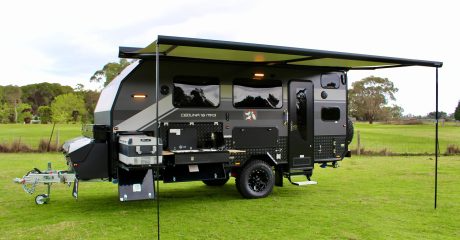
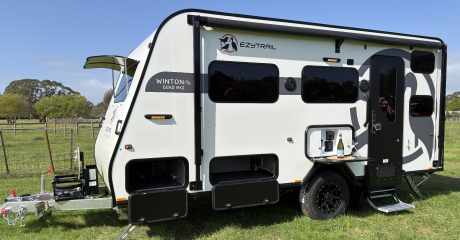
Designed for duo travellers (Or solo adventurers), the Airlie 11 HR Twin is the perfect compact off-road caravan for those seeking comfort and versatility.
The Airlie 18R is built for those who crave adventure without compromise, featuring an innovative rear-door design that enhances flow, space, and accessibility.
The Airlie 20R is a feature-packed off-road caravan, designed for luxury on the go. Inside, enjoy a modern kitchen, an abundance of storage, and a built-in washing machine for added convenience.
The Airlie 23 is designed for families who crave adventure without sacrificing luxury. Featuring four spacious bunks, a plush island bed, and endless storage.
The Parkes 14R Twin MK4 proves you don’t need extra length to travel without limits. Built for duo-travellers who want genuine off-road capability paired with modern comfort, this hybrid is engineered to go further with confidence.
The Parkes 15FRS Club redefines what compact touring can feel like. With both a fridge and microwave, it delivers practical convenience without compromising space.
Built for travellers who demand more, this van pairs massive 1190W solar capacity with a huge 12kWh lithium bank and full smart-system integration throughout.
The Parkes 16R Quad MK4 delivers serious off-road capability with the flexibility modern families need. Up front, a king bed easily folds away to create additional seating, while two bunks ensure everyone has their own space to recharge. An internal ensuite brings everyday convenience on the road, and the electric pop-top roof makes setup effortless — just press a button and relax.
Designed for couples who want serious off-road capability without the setup hassle, the Parkes 16R Twin MK4 makes adventure feel effortless. The permanent king bed means no unpacking — simply press a button, raise the electric roof and relax.
Finished with extensive external storage and a rear utility box, the Parkes 16R 3 Bunk is designed for families who want space, strength and freedom wherever the road leads.
The Ceduna 13R Twin MK4 is built for duo-travellers who want to go further without towing bigger. This agile hybrid blends genuine off-road capability with modern, homely comfort — proving compact doesn’t mean compromise. Powered by a 24V Victron system, you’ll have smart, reliable energy wherever adventure calls.
The Ceduna 15FRS Club MK4 is designed for travellers who want room to breathe without sacrificing capability. The rear club lounge creates a genuine living zone — more space to relax, dine and stretch out in comfort.
Built for adventurous families, the Ceduna 16R 3 Bunk MK4 combines serious off-road capability with the power, storage and comfort needed to make more of every journey.
The Ceduna 17F Twin MK4 is designed for travellers who want space, style and serious cooking capability on the road. Its open floor plan creates a light, spacious feel, centred around a true monster kitchen made for extended touring. Outside, the innovative parallel slide-out kitchen and external pantry offer added protection from the elements while expanding your prep space.
The Ceduna 17F Quad MK4 is designed to give families the space they need without compromising capability. A generous open-plan layout creates an airy, expansive feel, anchored by a true monster kitchen built for extended touring and serious meal prep. Outdoors, the parallel slide-out kitchen and external pantry enhance functionality while offering greater protection from the elements.
The VZ4800 HR Twin blends refined comfort with rugged off-road performance, delivering a touring experience that feels effortless from setup to sundown.
Ezytrail’s Winton 10 just levelled up. The all-new MK2 brings your favourite compact caravan to the next stage of comfort, convenience, and cutting-edge tech.
The Winton 13 MK2 is Ezytrail’s latest evolution in compact caravanning — a smart, spacious, and fully loaded 13ft van built for couples who want big features without the bulk.
The Winton 16F Twin combines modern comfort and smart technology in a streamlined 16ft layout, featuring a queen island bed, self-contained ensuite, café lounge with sofa bed and spacious kitchen.
Our practical guide to collecting, treating & storing potable water. Water is a balancing act for RV owners.
Ezy Tips
Our practical guide to collecting, treating & storing potable water
Water is a balancing act for RV owners. Take too much and you’re carrying unnecessary weight; take too little and you could be refilling from undesirable sources. Here’s our practical guide to collecting and keeping potable water fresh for longer.
The Source Is Important
There’s a logical order you should source your water from to minimise chance of contamination. Australia’s capital cities have excellent drinking water, as do many rural towns. So consider tap water unless otherwise advised before forking out a premium for bottled water, and always plan possible water sources into your itinerary so you’re not caught short.
Water may become contaminated from a range of sources, not limited to: animal droppings, dead animals, agricultural run-off, industrial waste, urban pollution such as stormwater and sewage from leaking septic tanks, during and after bushfires, floods and other extreme weather events. Therefore, it is important to understand the risk from each source.
In General, The Least To Most Risky Sources Are
Bottled spring or mains tap water
Rainwater
Spring
Bore
Running surface water (e.g. river/creek/stream)
Standing water (e.g. lake, pond, puddle)
Fill up with the best water you can, but if you come across better water, ditch what you have and re-fill. Preference fast-flowing, visibly clear water with no algae, odour, taste or scum accumulated on the surface and always consider what’s upstream.
When carrying limited water from multiple sources, use the worst water for boiling meals or taking a shower rather than directly drinking it. Provided your transfer mechanisms (hoses/piping) and storage container are food grade and properly maintained, you’re pretty safe with mains tap water. Water other than bottled or mains tap water should be treated to reduce contamination from heavy metals and pathogens which can cause enteric (gut) illnesses, including gastroenteritis, diarrhoea and intestinal parasites.
The young, elderly and people with weakened immune systems are most at risk from drinking contaminated water.
Different Treatment Options If possible, treat water before storage to reduce contamination of your tanks. If not, you may drink clean water (using an inline filter on the kitchen tap), but shower in contaminated water. That doesn’t sound appealing, does it?
In order of most to least effective, the most popular forms of treatment are
Boiling
Filtration
Chemical
UV
Let’s Talk Through The Pros And Cons Of Each.
Boiling
If you have the means, boiling is the most effective method for deactivating microbial contaminants such as bacteria (e.g. salmonella, E. coli), viruses (e.g. enterovirus, rotavirus, hepatitis), protozoa (e.g. Cryptosporidium, Giardia) and other parasites. This method is scalable to however much water you want to treat. At even the highest elevations in Australia, around one minute at a rolling boil is sufficient. This method isn’t compromised by the turbidity (cloudiness) of the water, but it cannot remove heavy metals, improve the appearance, smell and taste of water and does not prevent recontamination in storage. Use in combination with filtration and chemical purification for best results.
Filtration
Filtration can be used before or after boiling, or standalone. Filtration media is often carbon, ceramic or fibre and there are scalable solutions in the form of inline (drink-through straw, drink bottle style or tap), gravity/drip, squeeze or pump-through set-ups. Filters only trap microbial contaminants but don’t deactivate, and high pressure can force contaminants through filters. Filtration is the only reliable method of removing some heavy metals. Filters have a limited lifespan; therefore, it is important to follow the manufacturer’s instructions for maintenance and replacement. With all filters the finer the pore size, the more effective the filtration. Microfiltration (0.2-0.4μm) is suitable for most bacteria, protozoans and other parasites, but won’t reliably trap most viruses. Ultrafiltration (0.01μm) is recommended for filtering out viruses.
Filtration often improves the appearance, smell and taste of water but does not prevent recontamination in storage. Use in combination with boiling and chemical purification for best results.
Chemical
Chemical purification is popular due to its small size (liquid or tablet), ease-of-use and some ongoing protection from recontamination in storage. There are various chemicals available including halogens chlorine and iodine, and salts such as troclosene sodium, and different strengths depending on the risk of the source. Some chemicals work better against specific microbial contaminants than others, but chemical purification won’t remove heavy metals. Water must have low turbidity (filtering first is preferable), the correct pH, concentration and contact time. Dosing is flexible depending on the quantity of water being treated, but efficiency decreases with water temperature, and there is a wait time after treatment and a shelf life to consider. Iodine is not recommended for pregnant women, people with hypersensitivity and thyroid problems, and for periods longer than a few weeks. Chemical purification does impart odour and taste on water.
UV
Whilst UV imparts no odour or taste on water, it is the least popular and least effective method due to the difficulty of use. UV units require power and the water must be clear (pre-filtered.) Handheld units can only treat small quantities of water, won’t remove heavy metals nor improve the appearance, smell and taste of water and will not prevent recontamination in storage.
It is important to remember that all methods make water better, but not perfect, and how you store water is very important.
Storage considerations
Storage tank size should meet your estimated usage and any size/placement/weight (measured full) restrictions for your RV. Portable storage is smaller for hand carriage, and is useful when you can’t drive your RV close to the water source. Fixed options include underbody, floor, interior and exterior tanks that sit flat or upright. Whatever you choose, have multiple containers in the event of contamination or rupture so your entire water supply isn’t compromised.
Make sure all tanks, hoses and fittings are food grade and lock or seal up hose ends and containers when not in use. When storing water, fuller is better, but completely drain and dry out tanks if not storing water. A small amount of residual moisture can become a breeding ground for microbes.
Don’t Forget Tank Hygiene!
Water itself doesn’t spoil – contamination in water causes spoilage, therefore proper tank hygiene is vital. Follow the directions on your chosen chemicals for purification and water freshening, and these simple steps at least annually to clean out the biofilm that accumulates in your tank.
Half-fill the tank with water, add at least half a cup of bicarb soda and some vinegar until you get the desired bubbling and swish around or go for a bumpy drive, then empty.
Add dish soap to a half-filled tank, more swishing or bumpy driving, then rinse thoroughly.
Household bleach or specialised cleaners work, just follow the directions. While you can use pool chlorine, it corrodes some fittings. Using the bleach method, half-fill your tank with water, and add a cup of bleach to every 50 litres. Swish vigorously or go for another bumpy drive. If possible, leave in the tank for 12-24 hours.
Rinse out, half-fill your tank with water only and repeat until the smell and taste of bleach have disappeared.
If you’re using the tank again immediately, refill as normal. Otherwise, completely drain and dry out your tanks. They’ll be ready for your next adventure.
Having the right caravan emergency essentials helps you deal with common issues safely and get back on the road sooner. This guide covers practical caravan recovery and safety...
Discover the various caravan finance options available before you decide to buy a caravan in Australia. Learn how to work out what you can comfortably afford.
Not every trip calls for a rugged off-road van. Ezytrail explains when an on-road caravan is the smarter choice, what makes these vans so well suited to sealed-road...
Get in touch to book a viewing at your nearest Ezytrail showroom. One of our friendly team members will reach out to you directly to organise the best time for you to stop by!
 Touring Range