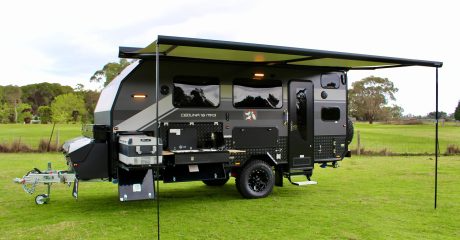
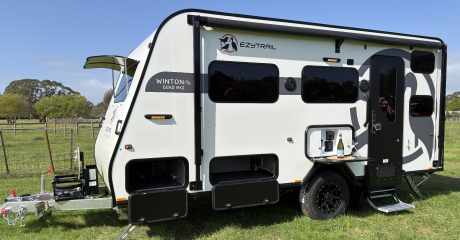
Designed for duo travellers (Or solo adventurers), the Airlie 11 HR Twin is the perfect compact off-road caravan for those seeking comfort and versatility.
The Airlie 18R is built for those who crave adventure without compromise, featuring an innovative rear-door design that enhances flow, space, and accessibility.
The Airlie 20R is a feature-packed off-road caravan, designed for luxury on the go. Inside, enjoy a modern kitchen, an abundance of storage, and a built-in washing machine for added convenience.
The Airlie 23 is designed for families who crave adventure without sacrificing luxury. Featuring four spacious bunks, a plush island bed, and endless storage.
The Parkes 14R Twin MK4 proves you don’t need extra length to travel without limits. Built for duo-travellers who want genuine off-road capability paired with modern comfort, this hybrid is engineered to go further with confidence.
The Parkes 15FRS Club redefines what compact touring can feel like. With both a fridge and microwave, it delivers practical convenience without compromising space.
Built for travellers who demand more, this van pairs massive 1190W solar capacity with a huge 12kWh lithium bank and full smart-system integration throughout.
The Parkes 16R Quad MK4 delivers serious off-road capability with the flexibility modern families need. Up front, a king bed easily folds away to create additional seating, while two bunks ensure everyone has their own space to recharge. An internal ensuite brings everyday convenience on the road, and the electric pop-top roof makes setup effortless — just press a button and relax.
Designed for couples who want serious off-road capability without the setup hassle, the Parkes 16R Twin MK4 makes adventure feel effortless. The permanent king bed means no unpacking — simply press a button, raise the electric roof and relax.
Finished with extensive external storage and a rear utility box, the Parkes 16R 3 Bunk is designed for families who want space, strength and freedom wherever the road leads.
The Ceduna 13R Twin MK4 is built for duo-travellers who want to go further without towing bigger. This agile hybrid blends genuine off-road capability with modern, homely comfort — proving compact doesn’t mean compromise. Powered by a 24V Victron system, you’ll have smart, reliable energy wherever adventure calls.
The Ceduna 15FRS Club MK4 is designed for travellers who want room to breathe without sacrificing capability. The rear club lounge creates a genuine living zone — more space to relax, dine and stretch out in comfort.
Built for adventurous families, the Ceduna 16R 3 Bunk MK4 combines serious off-road capability with the power, storage and comfort needed to make more of every journey.
The Ceduna 17F Twin MK4 is designed for travellers who want space, style and serious cooking capability on the road. Its open floor plan creates a light, spacious feel, centred around a true monster kitchen made for extended touring. Outside, the innovative parallel slide-out kitchen and external pantry offer added protection from the elements while expanding your prep space.
The Ceduna 17F Quad MK4 is designed to give families the space they need without compromising capability. A generous open-plan layout creates an airy, expansive feel, anchored by a true monster kitchen built for extended touring and serious meal prep. Outdoors, the parallel slide-out kitchen and external pantry enhance functionality while offering greater protection from the elements.
The VZ4800 HR Twin blends refined comfort with rugged off-road performance, delivering a touring experience that feels effortless from setup to sundown.
Ezytrail’s Winton 10 just levelled up. The all-new MK2 brings your favourite compact caravan to the next stage of comfort, convenience, and cutting-edge tech.
The Winton 13 MK2 is Ezytrail’s latest evolution in compact caravanning — a smart, spacious, and fully loaded 13ft van built for couples who want big features without the bulk.
The Winton 16F Twin combines modern comfort and smart technology in a streamlined 16ft layout, featuring a queen island bed, self-contained ensuite, café lounge with sofa bed and spacious kitchen.
Towing Off-Road – But What Exactly Does ‘Off-Road’ Mean?
Towing Off-Road - But What Exactly Does 'Off-Road' Mean?
Ezy TipsAdventure
Article by: RV Daily Words and Images Mark Allen
As a little tacker, Mum would tell me to go outside and play in the dirt. The ensuing hour-long soak in the tub to get the dirt and mud off my whole body and the half a container of Omo to wash the muck from my clothes, was not what she had in mind.
I was given no instructions, no limits, no idea… so, naturally, I just went for it.
Mum, on the other hand, thought I’d just go running around the yard, maybe get a little dusty and a simple hand wash would suffice before dinner.
So, when caravanners say they are taking their van ‘off-road’, what exactly does that mean? Simply towing at high speed on well-graded gravel highways, or low-range rock-rash inducing tracks that are more suited to a goat?
There is no single answer or type of ‘off-roading’, so before you hit the tracks, you need to ensure you’re decked out with the correct knowledge and gear to see you back for a warm shower at the end of the day.
My opinion, given the sheer weight and size of any off-road caravan, is that they cannot and will never be able to be towed where an off-road camper-trailer can. Take a long, hard think about what you really hope to do ‘off-road’ with a caravan. I own both an off-road caravan and a camper-trailer. Both have their pros and cons. The van weighs in at 2.5 tonnes, sports dual axles and is wider than my vehicle, while the single-axle camper tops a tonne fully loaded and runs in the same wheel tracks as my vehicle; that makes a huge difference to what a typical 4X4 can accomplish off-road.
I’m happy doing remote corrugated, rough, dirt tracks combined with a little low-range work with the van, but when the going gets tough, I’d hitch the camper up first choice every time.
For all those that drool over online videos of folk hauling full-sized vans through precarious tracks, I’ll bet you’ve never seen the damage bill at the end!
VAN SELECTION
The very first step of hitting anything other than the smooth, black bitumen roads is van selection. Getting this wrong will see you in all sorts of trouble, regardless of driving or tug ability, or any other accessory you may have fitted.
Forget about on-road caravans altogether – they won’t cut the mustard off-road. Instead, look for at least a off road hybrid caravans van to tackle graded gravel roads, or a dedicated heavy dutyoff-road van that will see you negotiating low-range tracks, sand and all manner of harder 4X4 pursuits.
Do keep in mind though, no matter how good your van is suited to off-road travel, it is akin to towing a huge anchor and will see you bogged much faster than not towing anything. Sand will knock the wind out of your sails, as will long stretches of sloppy mudand boulder-strewn tracks. Watch for low hanging trees too, they do a hell of a lot of damage to protruding awnings and high-mounted air conditioners.
Ensure you choose an off-road suspension package; no, it doesn’t have to be independent, trailing arm, coil-sprung or air-bagged set-ups. Good ol’ leaf springs can do the trick, but be sure they are adequately rated and return enough underbody clearance.
Tyres – as much as there is plenty of conjecture as to whether you need mud tyres or if an all-terrain pattern is sufficient, at least make sure you use an LT (Light Truck) designated tyre. These will providebetter resistance to punctures, are generally higher load rated and will see them far outlasting a P (Passenger) rated tyre. Do keep an eye on tyre pressures and remember to adjust up and down to suit the terrain, just like you do on your tow vehicle.
Choosing an off-road hitch should be high on your list too; specifically, one that not only returns maximum articulation, but is also easy to hitch and unhitch as well as being adequately rated to the weight of your van. If you intend on using load levelling bars, note that not all off-road hitches cater for them.
PREPARATION AND PROTECTION
Once you’ve purchased your new van, there are plenty of smaller additions that can be made to keep it in tip top condition.
I wouldn’t go off-road at all without a stone deflector fitted. Preventing stones, rocks and even being sandblasted by dirt from striking the front of your van should be considered high priority. Not only will you keep your van’s nose looking good, you’ll prevent stones bouncing back onto your tow vehicle and smashing a back window.
No matter how well sealed a van is, it pays to help prevent dust ingress. I liked the old-fashioned four season roof hatches, as you could leave the front-facing quarter open while driving to force fresh air into the van, which then pressurises the van body to help prevent dust being sucked in via rubber seals and smaller gaps. Alas, newer, rear-opening roof hatches can’t do that.
Some folk have plucked up the courage to cut a hole in their van’s roof to fit a forward-facing hatch or snorkel to help pressurise the van, but I’m not game enough to take to my roof with a saw yet!
I have, at times, stuck plastic film across some of my van’s vents to help keep dust out, but be warned not to block vents that allow heat from appliances to escape. My efforts have worked reasonably well, but do take some time to apply and remove.
Keeping your distance from vehicles ahead returns clean air not only into your vehicle, but also around your van. Other than creating stunning photos for magazines, there is no reason to tailgate on dirt roads.
If you really need to overtake someone, best to jump onto the UHF radio and holla nicely to those ahead if they would mind pulling over to allow you to pass safely. Do keep in mind the rocks that both their and your vehicles are throwing up, and keep a good distance apart so as not to send one through a window.
While we’re on the topic of stones being flung about, be sure your underbody water tanks, hoses, wiring and even shock absorbers (if you have them) are protected; it’s amazing the amount of damage that can result from fast gravel roads. Also, be sure your spare wheel is easily reached if needed.
When it comes to rubber, some vans’ tyres, including mine, are inflated from new with nitrogen – denoted by the green (instead of black) valve stem caps. While nitrogen offers some benefits, the chance of finding any out in the bush is akin to finding rocking horse poo, so best stick with plain ol’ air – plus, it’s free. You might consider fitting a tyre pressure monitoring system too. As soon as tyre pressures alter from a setamount, a warning goes off on your dash-mounted screen, letting you know to pullover to avoid a total blowout or further damage.
RECOVERY AND SKILLS
Sooner or later, you will get stuck, bogged or will be “no longer able to proceed”… call it what you will.
There is no shame in it, but every vehicle, with or without a caravan, should be equipped for self-recovery. 12V winches, recovery boards, jacks, bull bags and even a simple shovel should be carried. The more remote off-road you venture, the more gear you should carry; don’t rely on potentialpassers-by to help out.
Safety while using recovery gear is paramount; don’t chance injury or death by irresponsible use. If you’re not sure how to use a certain bit of recovery equipment, or not even sure about driving off-road with a van, book yourself into a course that is dedicated to off-road towing.
One of the main things that will put a stop to forward travel is lack of ground clearance. Check both approach angles (the longer the drawbar the more chance it’ll scrap going over a mound) and departure angles (upward sloping rear ends offer much less chance of dragging or scraping over the mounds). Weight is the biggest drawback of towing off-road; hauling a couple tonne of square home on wheels is no easy feat through soft sand especially, so ensuring your tow vehicle has plenty of power and torque is vital. So too is knowing how to drive the vehicle in any given scenario with the van on. Losing momentum in the wrong spot will see plenty of use of your recovery gear!
Using your aforementioned in-car UHF radio with a handheld unit makes for easy communication between driver and spotter to help in tricky off-road situations.
You’ll also want your van’s braking system to be up to scratch.Appropriate electronic braking systems are great off-road and can be a huge help in the right circumstances. Forget about using override brakes on heavy vans; not only are they illegal for use over twotonne, you’ll find the weight of your van has a terrifying ability to push you past your intended stopping point.
WHAT’S IT ALL WEIGH?
The onus is on you, the owner/driver, to be sure your tow vehicle is up to the task of towing your caravan. Loading both vehicle and van up ready for a trip and taking it all over a weighbridge is worth the small outlay in time and money, just to be sure your set-up remains legal and will last the rigours of rough roads.
Obviously, if you’re involved in some form of accident, you’ll need to be within the letter of the law to have any hope of an insurance claim. Even consider a policy that will insure you off-road and a company that will retrieve both your vehicle and van should the worst happen.
Don’t be put off taking your van off-road, but do be aware of the added dangers that come with towing off-road. Tagging along with others is always a safe bet; many hands make light work at recoveries.
Having the right caravan emergency essentials helps you deal with common issues safely and get back on the road sooner. This guide covers practical caravan recovery and safety...
Discover the various caravan finance options available before you decide to buy a caravan in Australia. Learn how to work out what you can comfortably afford.
Not every trip calls for a rugged off-road van. Ezytrail explains when an on-road caravan is the smarter choice, what makes these vans so well suited to sealed-road...
Get in touch to book a viewing at your nearest Ezytrail showroom. One of our friendly team members will reach out to you directly to organise the best time for you to stop by!
 Touring Range