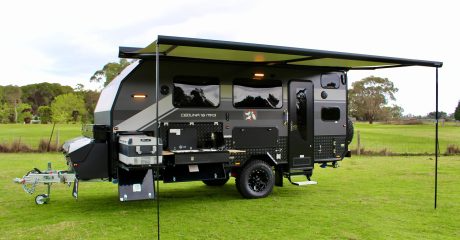
Designed for duo travellers (Or solo adventurers), the Airlie 11 HR Twin is the perfect compact off-road caravan for those seeking comfort and versatility.
The Airlie 18R is built for those who crave adventure without compromise, featuring an innovative rear-door design that enhances flow, space, and accessibility.
The Airlie 20R is a feature-packed off-road caravan, designed for luxury on the go. Inside, enjoy a modern kitchen, an abundance of storage, and a built-in washing machine for added convenience.
The Airlie 23 is designed for families who crave adventure without sacrificing luxury. Featuring four spacious bunks, a plush island bed, and endless storage.
The Parkes 14R Twin MK4 proves you don’t need extra length to travel without limits. Built for duo-travellers who want genuine off-road capability paired with modern comfort, this hybrid is engineered to go further with confidence.
The Parkes 15FRS Club redefines what compact touring can feel like. With both a fridge and microwave, it delivers practical convenience without compromising space.
Built for travellers who demand more, this van pairs massive 1190W solar capacity with a huge 12kWh lithium bank and full smart-system integration throughout.
The Parkes 16R Quad MK4 delivers serious off-road capability with the flexibility modern families need. Up front, a king bed easily folds away to create additional seating, while two bunks ensure everyone has their own space to recharge. An internal ensuite brings everyday convenience on the road, and the electric pop-top roof makes setup effortless — just press a button and relax.
Designed for couples who want serious off-road capability without the setup hassle, the Parkes 16R Twin MK4 makes adventure feel effortless. The permanent king bed means no unpacking — simply press a button, raise the electric roof and relax.
Finished with extensive external storage and a rear utility box, the Parkes 16R 3 Bunk is designed for families who want space, strength and freedom wherever the road leads.
The Ceduna 13R Twin MK4 is built for duo-travellers who want to go further without towing bigger. This agile hybrid blends genuine off-road capability with modern, homely comfort — proving compact doesn’t mean compromise. Powered by a 24V Victron system, you’ll have smart, reliable energy wherever adventure calls.
The Ceduna 15FRS Club MK4 is designed for travellers who want room to breathe without sacrificing capability. The rear club lounge creates a genuine living zone — more space to relax, dine and stretch out in comfort.
Built for adventurous families, the Ceduna 16R 3 Bunk MK4 combines serious off-road capability with the power, storage and comfort needed to make more of every journey.
The Ceduna 17F Twin MK4 is designed for travellers who want space, style and serious cooking capability on the road. Its open floor plan creates a light, spacious feel, centred around a true monster kitchen made for extended touring. Outside, the innovative parallel slide-out kitchen and external pantry offer added protection from the elements while expanding your prep space.
The Ceduna 17F Quad MK4 is designed to give families the space they need without compromising capability. A generous open-plan layout creates an airy, expansive feel, anchored by a true monster kitchen built for extended touring and serious meal prep. Outdoors, the parallel slide-out kitchen and external pantry enhance functionality while offering greater protection from the elements.
The VZ4800 HR Twin blends refined comfort with rugged off-road performance, delivering a touring experience that feels effortless from setup to sundown.
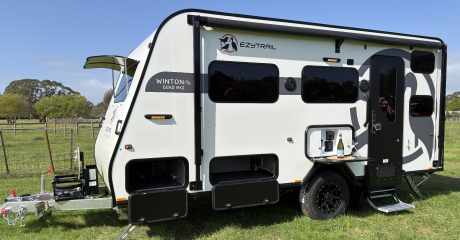
Ezytrail’s Winton 10 just levelled up. The all-new MK2 brings your favourite compact caravan to the next stage of comfort, convenience, and cutting-edge tech.
The Winton 13 MK2 is Ezytrail’s latest evolution in compact caravanning — a smart, spacious, and fully loaded 13ft van built for couples who want big features without the bulk.
The Winton 16F Twin combines modern comfort and smart technology in a streamlined 16ft layout, featuring a queen island bed, self-contained ensuite, café lounge with sofa bed and spacious kitchen.
Ye Who Prep Will Prosper: Safety Aids & Accessories
Jumpin’ in the car, slammin’ the door and takin’ off on holidays on a whim without a care in the world, is great. Great … but dumb!
Ezy TipsAdventure
Jumpin’ in the car, slammin’ the door and takin’ off on holidays on a whim without a care in the world, is great. Great … but dumb!
Did you lock the door on your way out? Did you feed the dog? Did you do the other dozen or more jobs that should be done prior to cranking over the holiday-mobile?
If you’ve answered ‘no’ to any or all of the above, my bet is you’ve forgotten a heap of important pre-trip van and tow vehicle preparation too.
Sure, you might get away with being an airhead once or twice, but it’s never a good idea to rely on good fortune. Let’s hit up some of the most important safety and accessory gear you really should have sorted before flushing the dunny that one last time (well, that’s the last thing I do before leaving on a big trip!)
IS THERE A DOCTOR IN THE HOUSE?
There are two specific areas of first aid here – personal, and mechanical.
A personal first aid course prior to any trip should be considered high on the list of priorities. The more remote you intend on travelling, the more important a basic first aid course should be – or, even better, a wilderness first aid course, if you plan on travelling remote. While simple first aid is pretty foolproof – anyone can slap a band-aid onto a minor scratch – it’s the more serious stuff (like treating severe misadventure or even saving a life) that needs greater knowledge in the form of training and qualifications.
Imagine if your partner busted a leg while hiking an hour away from camp, which in turn was days away from other medical help. What if it was a snake bite, or severe sunburn? Perhaps hypothermia or even an adverse reaction from that out-of-date tin of tuna you both ate? Would you be able to deal with a crisis or would you be booking an appointment with an undertaker?
Grim, perhaps, but not unrealistic.
Take into consideration the ages and personal requirements of your party, including medications. You need to be sure of what you are dealing with long before anything turns sour. Kids get sunburnt, twist ankles, break bones and knock bark off their knees; oldies (and even the not-so-old) have heart attacks, trip over, bump heads and, heaven help ‘em, leave their false teeth behind – would you know how to handle these incidents?
While you don’t need to be a trained nurse or doctor to leave home on an adventure, it pays to know as much as possible for that initial first aid action, as well as follow up actions. Let’s take my seven-year-old son’s recent accident, for example.
I was sitting around camp, enjoying the good life, when an excruciating scream pierced my ears some hundreds of metres away. I have four boys and somehow I knew which one it was, but until I’d sprinted that few hundred metres, I had no idea whether he’d fallen out of a tree, been bitten by an animal, whacked on the head by one of his brothers or, as it turned out, come a-cropper on his bike at a million miles an hour on a downhill, rough gravel road. He had his helmet on, but his T-shirt and shorts were no match for the gravel.
‘Oh sh!t’ was my initial reaction, followed by a quick scan to check for bones that may have snapped, teeth that may be missing, or body parts that may be caught in the bike. There was plenty of blood and skin missing, along with some gruesome gashes, but luckily nothing more serious.
While we were able to clean most of the dirt from his wounds, treat him for shock and comfort him, it was evident that stitches were in order, along with more thorough wound cleaning and sterilisation. Our next course of action was to leave camp for the closest hospital, luckily only about an hour away, at which he was mended for a long and slightly painful rehabilitation.
Did we get it all right at the time? Nope. There are some parts I’d do differently, but all things considered, we did alright thanks to a well-stocked first aid kit and enough knowledge to do the best we could in the situation.
Vehicle first aid shouldn’t be taken lightly either. Firstly, ensure that everything is up to scratch and serviced prior to departing but even so, just like people, things can go wrong with your vehicle while out on the road. While not everyone can be a mechanic, you’d be well served knowing the basics of your vehicle and how it operates. Carrying the basic parts for emergency breakdowns and the tools to affect those repairs is a must. A toolbox may seem like a deadweight, but it’ll be worth its weight in gold if you ever need to rely on it. Even if you can’t complete the job, a fellow traveller may be able to help if you ask nicely. Oh, and don’t forget your manners with a heartfelt thanks and offer of payment, if necessary.
Carrying enough fuel for the job is critical, too. Do you know how much you’ll need to cross the Simpson Desert? Running dry is not an option
– it’s a long and deadly walk if you get it wrong!
PLUG IT OR PATCH IT?
Following on from carrying your own tools and basic spare parts, knowing how to fix a simple flat tyre is a must-have skill. Given most car and 4WD tyres are tubeless, plugging a hole in the tread area of your tyre is pretty easy, provided you carry a tyre repair kit. While popping a bead, removing a tyre from the rim and reseating it is a bigger and harder job, it’d be wise to know how to do it, as well as carrying the few extra tools if you are heading far from the main roads. Carrying more than one spare is prudent too, as is the ability to swap them over if needed.
Be warned though, while repairs to the tread area are acceptable, sidewall repairs are generally frowned on and should only be done as a last resort to get you out of a pickle. Having a tyre repair shop check your handiwork as soon as possible is also wise if you think your skills may be lacking a little … better to err on the side of safety, after all.
Personally, I carry a simple bead breaker, two tyre levers, tyre patches as well as tyre plugs. On our last holiday, I patched 18 – yep, 18 – damn punctures over five days on my kids’ bike tyres (as result of riding around paddocks full of evil bindies). You just need to remember to restock your supplies before your next trip if you do end up using them.
GET ME OUTTA HERE
If you take your 4X4 off-road, you’ll probably get stuck at some point if you haven’t already. You really don’t need to venture too far off the blacktop to become a victim of the dreaded bog hole. I have. It’s a damn nuisance, but with some simple gear, it should be nothing more than a delay. Of course, there are dozens of different ways to get stuck in each type of terrain, so carrying a suitable recovery kit is vital. Perhaps you’ll only be delayed for that short period, but what if you’re properly bogged and just sitting, waiting, twiddling your thumbs, praying that someone else will bounce on in to rescue you? Being self-sufficient with food, water and fuel is equally important. In addition to carrying all the right gear, be sure you know how to use it safely; too many times we hear about the lethal results of incorrect use of recovery gear.
EXTINGUISH IT
Fire extinguishers, fire blankets, fire alarms and even carbon monoxide alarms are all pieces of equipment you hope you never need. Having them on hand for that ‘just in case’ scenario could well and truly save you or your family’s life.
Ensuring each life-saving device is in useable condition is paramount – regularly checking batteries, use-by dates and serviceability of each device should be likened to checking oil and water in your tow vehicle. Forget it, and you’ll pay the consequences sooner or later.
A tip for powder type extinguishers: from time to time, remove them from their cradles, give ‘em a good shake to loosen the (potentially) compacted powder, check there is adequate charge (generally indicated as showing in the green), check the dates ‘n’ tags, replace your extinguisher if necessary (or have it checked professionally) and re-secure it in the proper easy-access cradle … not hidden under the bed or the bottom cupboard.
Just like your recovery gear, knowing how to use these appliances is critical in fire emergencies – you simply can’t afford to dilly dally around reading instructions while everything burns down around you.
COMMUNICATIONS
EPIRB, PLB, UHF and HF radios, smartphones, sat phones, trackers, online and offline mapping systems … the ever-increasing emergency systems are all well and good – if you’ve got them with you.
With so many forms of high tech communications available these days, it would pay to investigate and weigh up your options depending on time away from home, remoteness of travel, as well as type or mode of travel. Added to that, there are systems available that allow emergency services as well as family and friends to track your whereabouts.
While I realise the limitations of the smartphone, they can be used for great effect in so many ways other than making phone calls. I have the (free) Emergency+ app that instantly gives me my GPS coordinates, an address (if applicable), and my current position overlaid on a map – all critical info that you can pass onto the relevant authority. The app also contains all the emergency contact numbers (not just 000), including SES, Police Assistance, Crime Stoppers, Health Direct, Poisons Info, and National Security.
PRE-TRIP PREPARATION
As we noted at the top of this article, pre-trip preparation can make or break the whole experience. I’ll admit to varying degrees of trip preps over the years, having ranged from the vague “anticlockwise until I get back home” for my first big lap of Australia, right down to detailed trip notes and tulip diagrams for events that I’ve coordinated. While neither is typical of most holidays, the point is, some form of preparation before leaving the safety of your home should be considered in order to make the most of your time on the road. Imagine if you missed the most superb views in the country by a mere couple of kays because you didn’t bother to research the area you were travelling in.
On the road, searching the internet is easy these days with WiFi hotspots in most caravan parks as well as various places in most towns, so tapping the keys every now and then should return plenty of local, hidden surprises. But the old fashioned way of walking into tourist information shops, reading signs, books and brochures, as well as asking the old fella at the end of the local bar, can all lead to fantastic experiences that you simply wouldn’t be able to get online.
And when it comes to driving skills, it’s one thing to hold a driver’s licence, but knowing how to drive off-road is extremely important and so much different to cruising the blacktop. Either learning from a proficient mate, doing an off-road driving course as well as a towing course or joining a club that will teach you may well make or break your trip. It’s no fun being stuck, wondering and watching while everyone else tackles obstacles with ease.
The more prepared you are as a traveller, the better the travelling experience you’ll have; so prepare, go forth and prosper.
Having the right caravan emergency essentials helps you deal with common issues safely and get back on the road sooner. This guide covers practical caravan recovery and safety...
Discover the various caravan finance options available before you decide to buy a caravan in Australia. Learn how to work out what you can comfortably afford.
Not every trip calls for a rugged off-road van. Ezytrail explains when an on-road caravan is the smarter choice, what makes these vans so well suited to sealed-road...
Get in touch to book a viewing at your nearest Ezytrail showroom. One of our friendly team members will reach out to you directly to organise the best time for you to stop by!
 Touring Range